
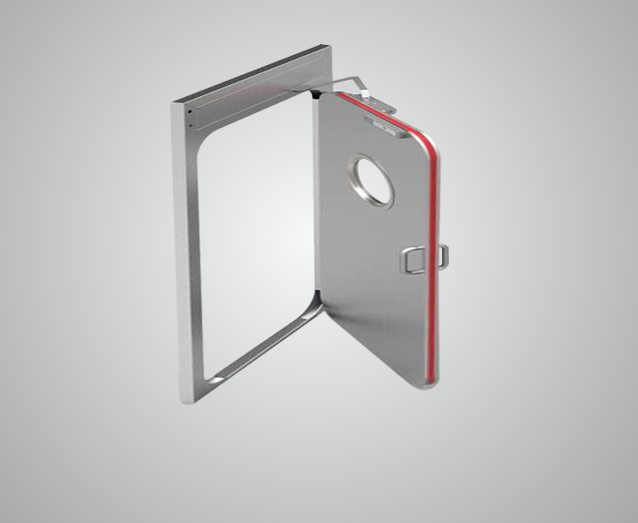
生物安全气密门
(生物安全充气式密闭门)
高级别生物安全实验室建设过程中,气密性是保证实验室空气洁净度、室内实验人员和室外环境安全的重要手段。气密门是具有气密性要求的高等级生物安全实验室围护结构中不可或缺的重要组成部份,广泛应用于有气密性要求的房间,以保证实验室围护结构的气密性。生物安全气密门分为二种,一种为充气式气密门,一种为机械压紧式气密门。
实验室防护区围护结构的气密性就达到在关闭受测房间所有通路并维持房间内的温度在设计范围上限的条件下,当房间内的空气压力上升到500PA后,20min内自然衰减的气压小于250PA。房间相对负压值达到-500Pa,经20min自然衰减后,其相对负压值不应高于-250Pa.
充气式气密门主要由门框、门板、充气密封条,控制系统组成,其中充气密封条安装于门页侧面的凹槽内。其工作原理为:门开启时,充气密封条收缩于凹槽内。门关闭时,密封条自动充气膨胀,使门与门框之间形成严格密封,同时门被紧紧锁紧。
充气密封式气密门分为单气囊和双气囊两种类型,其中双气囊充气密封式气密门具备现场气密性自检测功能。其性能指标包括结构抗压力、充气密封胶条的充放气时间、充放气次数、气密性等。
特点
ü 全密封结构设计
ü 密封性压力监测
ü 供应气体压力监测
ü 专制气密门铰链
ü 独立PLC控制
ü 可配置按钮和LED指示灯
ü 可安装可视视窗
应用领域
气密门广泛应用于高等级生物安全实验室、消毒室、隔离室等卫生安全领域。
Biosafety airtight door
(Biosafety inflatable airtight door)
In the construction process of high-level biosafety laboratories, airtightness is an important means to ensure the cleanliness of laboratory air.
1. Structural Pressure Resistance: The door must be able to withstand a certain amount of pressure to prevent any leakage of air or contaminants. The structural pressure resistance should be greater than 2500 Pa.
2. Inflation and Deflation Time: The time it takes for the inflatable sealing strip to inflate or deflate should be within 5 seconds to ensure quick and efficient sealing and unsealing of the door.
3. Inflation and Deflation Frequency: The inflatable sealing strip should be durable enough to withstand a high number of inflation and deflation cycles, typically over 10,000 times.
4. Airtightness: The door should maintain a high level of airtightness, with a leakage rate of less than 0.25% vol/h even under a pressure difference of ±500 Pa.
5. Safety Redundancies: The door should have safety features such as emergency stop buttons and manual deflation valves to prevent the door from being stuck in case of electrical or pneumatic failure.
6. Corrosion Resistance: The door should be constructed from materials that can resist common disinfectants and cleaning agents, ensuring longevity and reliability in a laboratory environment.
7. Locking Mechanis: The door should have a robust locking mechanism, such as an electromagnetic lock, to ensure that it remains securely closed when not in use.
8. Mutual Interlocking: For areas requiring multiple doors, the doors should have an interlocking system to prevent the opening of one door without the proper sequence or conditions being met.
9. Customizability: The door should be customizable to meet specific user requirements, such as integrating access control systems for added security.
10.Self-Testing Function: For double airbag inflatable sealed airtight doors, an on-site airtightness self-testing function is beneficial to ensure the door's performance is maintained.
These features ensure that inflatable airtight doors are not only effective in maintaining the necessary containment conditions within high-level biosafety laboratories but also safe and reliable for the personnel using them. The doors play a critical role in preventing the escape of potentially hazardous biological materials and ensuring the safety of both the laboratory workers and the external environment.
TAG: 生物安全气密门 / 生物安全密闭门 / 充气门 / 实验室门 / 充气气密门 / P3实验室门 / P4实验室门 / 高等级实验室门 Biosafety door/Biosafety seal door/ Inflatable airtight door / P3 door / P4 door / High level lab door / Hermetic door /